AI Domain Name Generator vs Traditional Brainstorming: Which Is Better?
Naming your business is one of the first big decisions you’ll make. A strong domain name makes your business easy to find, easy to remember, and easy to trust. A weak one gets lost, misspelled, or ignored.
So, which method actually gets you a name people can find, remember, and trust, an AI domain name generator or your own brainstorming session? Both can work. The right pick depends on how much time you have and how specific your brand story needs to be. Once you settle on a name, you can create a logo that brings your brand identity to life.
This guide compares both approaches. You’ll see how each one works, where each one falls short, and how to combine them for better results.
Business Name vs. Domain Name
Before we get into which method to use, it helps to get one thing straight first. Business name and domain name are often mixed up, but they mean different things.
Knowing the difference between a business name and a domain name early saves you from confusion later, especially once you start checking availability for each one.
| Business Name | Domain Name | |
| What it is | Your brand identity | Your web address |
| Where it shows up | Signage, invoices, marketing, and legal paperwork | Browser bar, email addresses, links |
| Example | Fresh Earth Meals | freshearthmeals.com |
| Can it change | Rarely, since it’s tied to your legal and brand identity | More often, since extensions and variations offer flexibility |
| What you check | Business registries and trademark databases | Domain registrars |
These often match, but not always. The domain that matches your business name might already be taken or priced out of reach.
Many businesses end up using a shortened version, a different word order, or a new extension instead.
Naming Methods, Explained
Before comparing how each method performs, it helps to see how each one actually works. Here’s a quick look at both, starting with the traditional approach.
What is traditional brainstorming?
Traditional brainstorming is the process of coming up with a domain name on your own, without software. You write down words, test combinations, and check them against a domain registrar as you go. It’s slower, but it puts you fully in control of every idea on the page.
Traditional brainstorming often starts with a notebook, a whiteboard, or a simple list. You might pull from your business’s story, your values, or a word that means something to you personally. There’s no algorithm involved, just your own judgment shaping each option.
What is an AI domain name generator?
An AI domain name generator is a tool that suggests domain names, including extensions such as .com and .co, based on the inputs you provide. You type in keywords, a short description of your business, or your industry. The tool returns a list of domain name options built from those inputs.
BrandCrowd’s domain name generator is one example.
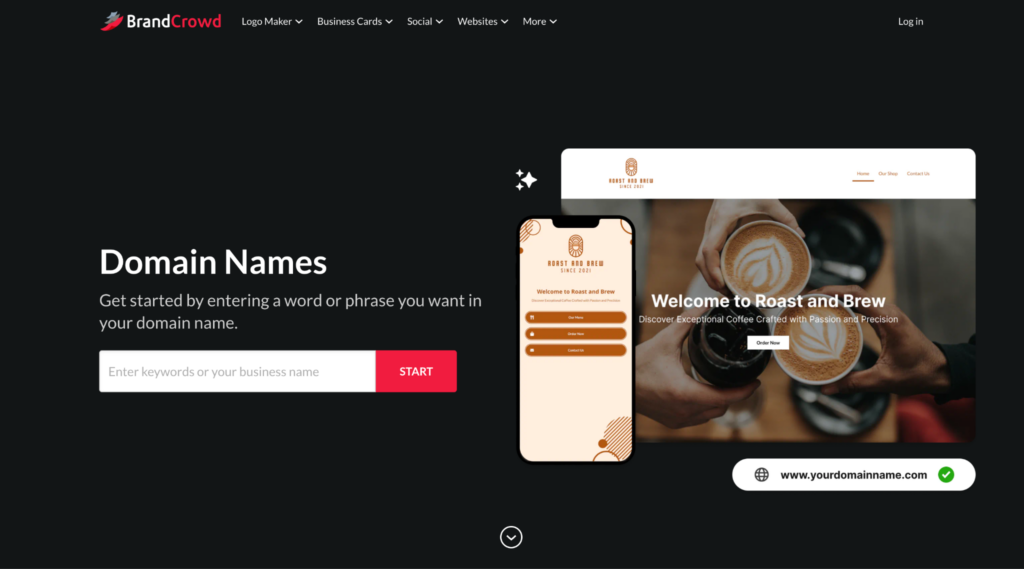
Here’s how it works. You enter a business name, a keyword, or a short description. The tool generates a list of suggestions right away. You can filter results by extension, such as .com, .co, or .io. Many suggestions also show if the domain is currently available.
Quick Comparison
Before going further, here’s how the two methods stack up side by side. Use this table as a quick reference, then read on for more detail on each point.
| Factor | AI Domain Name Generator | Traditional Brainstorming |
| Speed | Fast. Dozens of names in seconds | Slower and more deliberate |
| Idea volume | High | Lower, but often more focused |
| Creativity | Can feel generic | Strong for story and tone |
| Cost | Often free or low-cost | Free, but takes time |
| Availability checking | Often built in | Needs a manual check |
| Trademark awareness | Cannot verify | Cannot verify |
| Best for | Fast ideation, breaking creative block | Names with a specific story or meaning |
Comparing the Two Methods Round by Round
The table above gives you the short version. The four rounds below break down why each method scores the way it does, so you can see the reasoning rather than just the results.
Round 1. Speed and idea volume
AI wins this round. A generator can produce dozens of domain names in seconds. That’s useful early on, when you’re not sure what direction to take and just need options to react to.
Brainstorming takes longer. A person can only hold so many ideas in their head before running out of steam. That’s not a weakness. It just means the process moves at a different pace, one built for depth instead of volume.
Round 2: Creativity
This round goes to human brainstorming. People bring humor, memory, emotions, and cultural context to naming, which a tool can’t fully replicate. A founder who knows their audience well might land on a name with real personal meaning.
AI-generated names tend to be solid, but they can also sound generic. This happens most when the input keywords are broad. Distinctive, story-driven names usually come from a person, not a prompt.
Round 3. Cost
AI tools are usually free or low-cost, and many generators don’t charge anything for the initial list of suggestions. Brainstorming is also free, but it costs time rather than money, and time has its own value depending on how quickly you need to launch.
Costs can add up on either side. Premium AI tools or paid domain suggestions carry a price tag, and long brainstorming sessions can delay other parts of getting your business off the ground.
Round 4. Availability checking and trademark awareness
Neither method wins this round. An AI generator can tell you if a domain looks available right now. It cannot tell you whether that name is free of trademark conflicts or safe to build a business around in the long term.
Brainstorming has the same gap. A name you came up with yourself still needs the same checks. No method skips this step for you.
AI Domain Name Generator in Action
To see how the two methods play out, imagine you’re creating a domain name for a meal-delivery business called Fresh Earth Meals.
Brainstorming would get you to a shortlist fast, since you already know the business name and can build variations from it yourself. That shortlist still needs the same work behind it, though. You’d still have to check each option against a domain registrar, search for trademark conflicts, and confirm the matching social handles are open before picking one.
BrandCrowd’s domain name generator walks you through the process in three steps. You start by entering your business name, and it shows you available domains along with other options you might like just as much. Just like the results below:
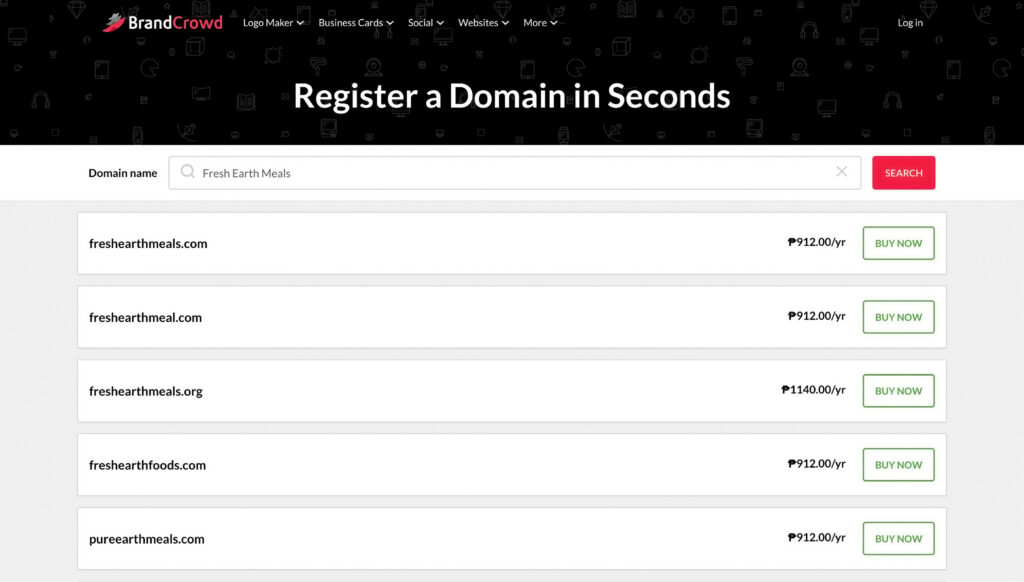
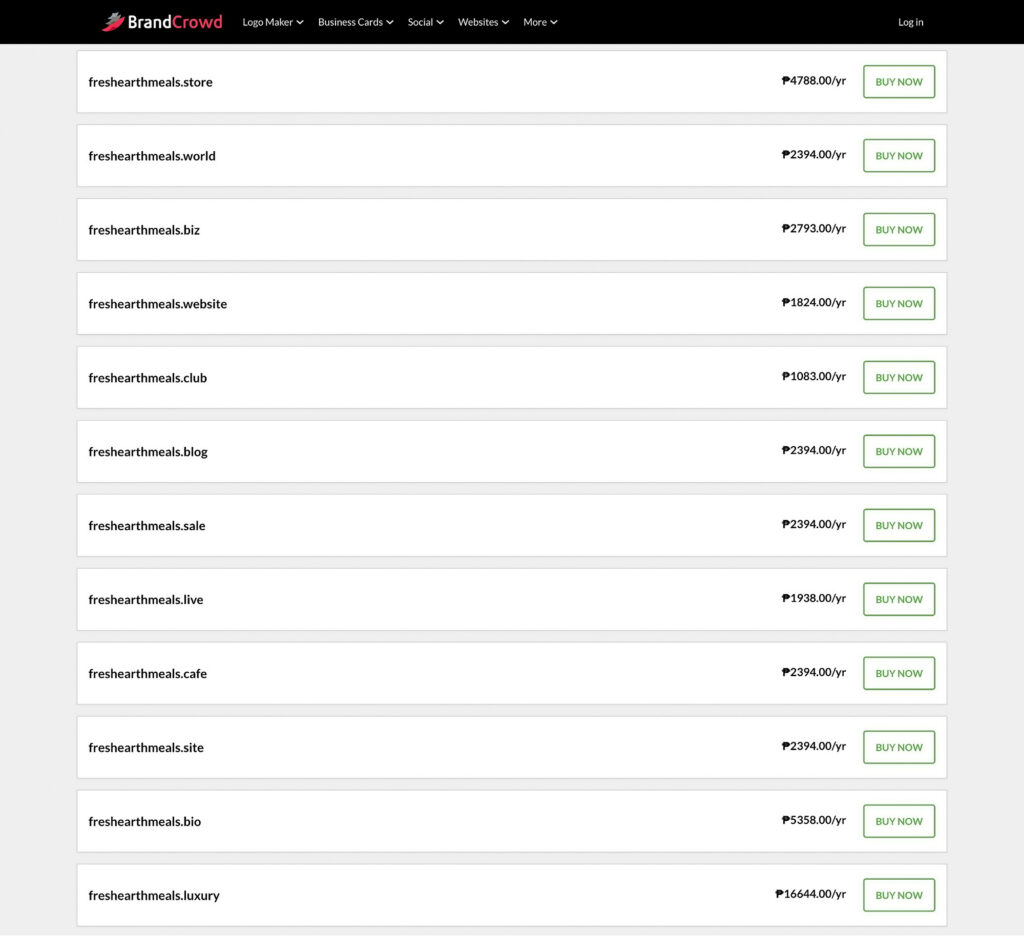
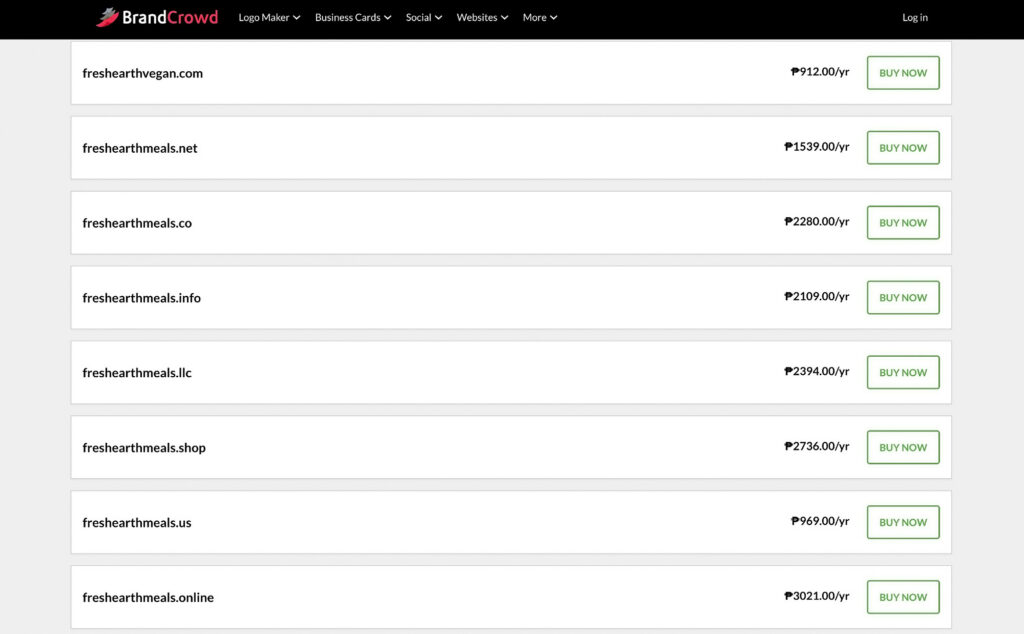
From there, you choose a domain based on how well it fits your brand, how easy it is to remember, how it reads for SEO, whether it risks a trademark issue, and whether the extension suits your business. Once you’ve picked one, registering it takes just a few minutes.
Brainstorming can get you to a similar shortlist, but you’re doing every one of those checks yourself, one by one. BrandCrowd folds several of them into the same search and selection process, which is where the time savings actually show up, not just in how fast the initial list appears.
Choosing Your Approach, or Combining Both
By now, you’ve seen where each method wins and where it falls short. Here’s how to turn that into a decision.
Lean on AI when:
- You’re starting from nothing and need momentum
- You want to see a range of naming styles fast
- You’re working in a fast-moving space and need options today
Lean on brainstorming when:
- Your brand has a specific story or personal meaning you want the name to carry
- You’re in a niche where generic names would blend in instead of standing out
Most strong domain names come from combining both instead of picking one. Here’s a process you can repeat every time you need a new name.
- Write down your audience, tone, key benefits, and industry in a few sentences
- Feed those details into an AI generator instead of a single keyword. Detailed prompts return far better results
- Shortlist the names that feel memorable, not just the ones packed with keywords
- Check domain availability directly with a registrar
- Check trademark status for your industry and region
- Check that the name is open across the social platforms you plan to use
- Say the name out loud to someone else and watch how they react. Their reaction, and how they spell it back to you, tells you a lot
Picking the Right Domain Extension
Your extension should match your business type, your audience, and where you operate. Here’s a general guide:
- .com works well for most consumer-facing businesses, since it’s what people expect to type by default
- .net is a common fallback when the .com version is taken, often used by tech and service businesses
- .org signals a nonprofit, association, or community-focused group, though some businesses use it too
- .co suits startups and smaller brands that want a shorter, modern alternative when the .com is taken
- .io is common among tech and software businesses, though it carries less meaning outside that space
- .info fits sites built around resources, guides, or informational content rather than a storefront
- .shop fits ecommerce and retail businesses directly, since it signals what the site does before anyone clicks
- .llc works for a registered LLC that wants its domain to match its legal business structure
These are just a handful of the options out there. Hundreds of extensions exist beyond these, covering specific industries, locations, and business types, so it’s worth checking what’s available before settling on one.
Final Thoughts
There’s no clear winner between an AI domain name generator and traditional brainstorming. AI is fast and gives you volume, especially when you’re stuck. Brainstorming brings the story and personal meaning that make a name feel like yours.
The most reliable path uses both. Generate a wide pool of names with AI, then apply your own judgment and the required checks to narrow it down.
If you want to see this in action, BrandCrowd‘s domain name generator is a solid place to start, and once you’ve locked in a name, tools like BrandCrowd’s logo maker, business card generator, and website builder can help you build out the rest of your brand identity around it.
FAQs on Domain Name Generation
What is an AI domain name generator?
It’s a tool that suggests domain names, complete with extensions, based on keywords, a business description, or your industry. It uses those inputs to build a list of relevant domain options in seconds.
How does an AI domain name generator work?
You enter a business name, keyword, or short description, and the tool generates a list of domain suggestions right away. You can usually filter results by extension, and many suggestions show availability alongside the name.
Is an AI domain name generator better than brainstorming?
Neither one is better across the board. AI is faster and gives you more options. Brainstorming tends to produce names with more personal meaning. Using both together usually works best.
What are the advantages of using AI to generate domain names?
AI can produce dozens of domain names in seconds, which helps when you’re stuck or need a wide range of options fast. Many generators also check availability and automatically mix in different extensions, saving you a step you’d otherwise have to do manually.
Can AI create unique domain name ideas?
AI can suggest names you might not think of on your own. An available domain isn’t automatically unique, though, so you still need to check it against trademarks separately.
How do I choose the best domain name for my business?
Judge shortlisted names on spelling, pronunciation, relevance, and room to grow. Then check domain availability, trademark status, and social handle availability before you decide.
Should I use AI or brainstorm manually when naming a website?
Use AI when you need speed and volume, and lean on brainstorming when your brand needs a name built around a specific story or personal meaning. Most businesses land on a stronger name by using both, starting with AI for options and brainstorming to refine them.
How can I check whether an AI-generated domain name is available?
Most generators show availability next to each suggestion. Confirm it directly with a domain registrar before you commit, since availability can change quickly.
Read more on branding here:
- Brand Purpose: The Ultimate Guide to Building a Meaningful Brand
- How to Come Up With a Business Name
- How To Do Logo Testing
Hannah Suroy suroy brings clarity to complex topics across entertainment, business, and creative industries. She specializes in translating industry trends and innovations into engaging content that helps readers understand the creative process behind the work they love.